Exam Review
- A)Atrial flutterB)Atrial fibrillationC)SVTD)Sinus tachycardia
- A cardiac pacemaker might be indicated in all of the following except:A)sinus arrhythmiaB)post cardiac surgeryC)third-degree AV blockD)bradyarrhythmias
- What is the most likely rhythm shown in this ECG strip?
A ✓ Correct 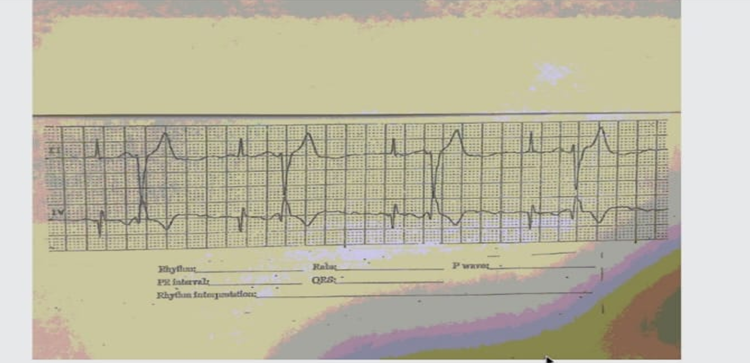 A)Sinus rhythm with ventricular BigeminyB)Atrial fibrillationC)Ventricular tachycardiaD)Complete heart block
- You are the charge nurse of the coronary care step-down unit. Which patient is best to assign to an RN who has floated for the day from the general medical-surgical unit?A)A patient receiving IV furosemide (Lasix) to treat acute left ventricular failure.B)A patient requiring discharge teaching about coronary artery stenting prior to going home today.C)A patient just transferred from the radiology department after a coronary angioplasty.D)A patient just admitted with unstable angina who has orders for a heparin infusion and aspirin.
Exam Review
- A nurse is providing instructions to a client who has a new prescription for sublingual nitroglycerin (Nitrostat) to treat angina pectoris. Which of the following instructions should the nurse include?A)"Place the tablet under your tongue"B)"The medication can take up to 15 minutes to take effect."C)"Stop taking the medication and notify your provider if you develop a headache."D)"Avoid taking the medication prior to exercising."
- The patient is experiencing V-Tach with a pulse and presents with a blood pressure of 70/42, mental status changes, and is clammy and pale. The RN prepares the patient for which of the following?A)Obtain a blood sampleB)Synchronized cardioversionC)DefibrillationD)CPR
- When caring for a patient with ACS (Acute Coronary Syndrome) who has returned to the coronary care unit after having a PCI (percutaneous coronary intervention), the nurse obtains these assessment data. Which piece of data indicates the need for immediate intervention by the nurse?A)Blood pressure 104/56 mm HgB)Chest pain level 8 on a 10-point scaleC)Pedal pulses 2+D)Heart rate 100 bpm
- Which antidysrhythmic would the nurse expect a 3 to 6 second run of asystole to follow?A)LidocaineB)AdenosineC)AtropineD)EpinephrineE)Amiodarone
Exam Review
- Which serum levels should be monitored when the client is taking a statin drug?A)Complete blood countB)Cardiac enzymesC)Blood urea nitrogenD)Liver enzymes
- It is the end of your 12 hour shift. The patient consumed: 1 cup of coffee, one 3-oz cup of juice, 240 ml of milk, 210 ml of milkshake, 12 ounces of tea, 3 oz of jello, one 12 oz cola, and 150 ml of water with meds. What is the patient's 12 hour oral intake you will document in mL?A)1740 mlB)58 ouncesC)1590 mlD)53 ounces
- Upon finding a client in cardiac arrest, the RN should administer which of the following drugs first?A)AtropineB)AtenololC)AmiodaroneD)Epinephrine
- A nurse is reviewing the EKG strip of a client who has prolonged vomiting. Which of the following abnormalities on the client's EKG should the nurse interpret as a sign of hypokalemia?A)Elevated ST segmentB)Inverted P waveC)Abnormally prominent U waveD)Wide QRS
Exam Review
- A patient with diabetes mellitus is admitted unresponsive to the emergency room. Initial laboratory findings are serum potassium 2.8 mEq/L, serum sodium 138 mEq/L, serum chloride 90 mEq/L, and blood glucose 628 mg/dl. Cardiac monitoring shows multifocal premature ventricular contractions (PVCs). The nurse understands that the patient's PVCs are most likely caused byA)dehydration.B)hyperglycemia.C)hypoxemia.D)hypokalemia.
- The physician orders erythromycin 1 g in 100 mL of D5W to infuse in 30 minutes. Calculate the flow rate in milliliters per hour using an "IV" pump. Whole numberA)200 ml/hrB)100 ml/hrC)300 ml/hrD)50 ml/hr
- The patient has Pepcid 20 mg IVPB every 12 hours ordered for prevention of gastric ulcers. The Pepcid is supplied as 20 mg/50 mL. The directions are to infuse in over 30 minutes. What rate do you set the pump? Whole numberA)100 ml/hrB)50 ml/hrC)20 ml/hrD)40 ml/hr
- When interpreting the EKG, the nurse would keep in mind which of the following about the P wave? Select all that apply.A)Identifies ventricular muscle depolarizationB)Reflects atrial muscle depolarizationC)Indicates electrical impulse beginning in the AV nodeD)Reflects electrical impulse beginning at the SA node
Exam Review
- A nurse is caring for a client with a ventricular pacemaker who is on ECG monitoring. The nurse understands that the pacemaker is functioning properly when which of the following appears on the monitor strip?A)Pacemaker spikes before each QRS complexB)Pacemaker spikes with each T waveC)Pacemaker spikes before each P waveD)Pacemaker spikes after each QRS complex
- You have just received change-of-shift report about these patients on the coronary care step-down unit. Which patient will you assess first?A)A 45-year-old with constrictive cardiomyopathy who developed acute dyspnea and agitation about 1 hour before shift change.B)A 26-year-old with heart failure caused by congenital mitral stenosis who is scheduled for balloon valvuloplasty later today.C)A 77-year-old who transferred from intensive care 2 days ago after coronary artery bypass grafting and has a temperature of 100.6 degrees F.D)A 56-year-old who had a coronary angioplasty and stent placement yesterday and has complained of occasional chest pain since the procedure.
- The nurse is preparing to administer adenosine to a patient with SVT (supraventricular tachycardia). Important considerations before administration include which of the following? (Select all that apply)A)Rapid saline flush following administrationB)Rapid IV push administrationC)Initial recommended dosage of 12 mg IV bolusD)Long half-life of adenosine, which may prolong adverse medication effectsE)Constant EKG monitoring
- A nurse is providing teaching to a client who has a permanent pacemaker and has just had the initial pacemaker check. Which of the following client statements should the nurse recognize as an understanding of the teaching?A)"The pacemaker can be checked from home by using the telephone."B)"My pacemaker will need reprogramming if I stand too close to a microwave oven."C)"The next pacemaker check will be when the batteries need to be replaced."D)"I will take my pulse weekly."
Exam Review
- Mr. B has been admitted to the CCU with an acute onset of atrial fibrillation with a ventricular response of 155 bpm, respirations 28, BP 100/60, skin warm and dry, and he is complaining of feeling weak with his heart racing. The purpose of the anticoagulants is:A)all of theseB)reduce thromboembolic complicationsC)convert the rhythm to a normal sinus rhythmD)control the ventricular response
- A nurse is caring for a client 2 hours following a cardiac catheterization. Which following actions should the nurse take?A)Have the client lie flat in bed with leg straight.B)Keep the affected leg slightly flexed.C)Elevate the head of the bed 45°.D)Keep the client NPO for 4 hr.
- In order to perform synchronized cardioversion, the nurse must verify that:A)all of these answers.B)the patient is not in ventricular fibrillation.C)the monitor is in the "sync" mode.D)the monitor recognizes and marks the patient's QRS complexes.
- A nurse is caring for a client who has a cardiopulmonary arrest. The nurse anticipates the emergency response team will administer which of the following medications if the client's restored rhythm is symptomatic bradycardia?A)MagnesiumB)AtropineC)EpinephrineD)Sodium bicarbonate