Exam Review
- Which letter is labelling the ala of the nose?
A ✓ Correct 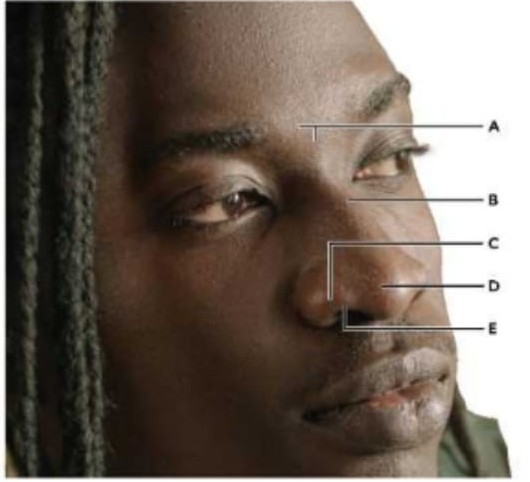 A)CB)DC)ED)BE)A
- What is the role of oxygen in a cellular respiration?A)It acts as a nutrient source.B)It forms carbonic acid.C)It is the final electron acceptor.D)It directly generates AТР.
- What is NOT a function of the nose?A)Producing digestive enzymesB)Housing olfactory receptorsC)Filtering and cleaning airD)Resonating speech sounds
- Identify the structures labelled by the following letters: D M H T ▾ Uvula ▾ Hard palate ▾ Trachea ▾ Vocal cordDropdown 1:Option 1: UvulaOption 2: Hard palateOption 3: TracheaOption 4: Vocal cordDropdown 2:Option 1: UvulaOption 2: Hard palateOption 3: TracheaOption 4: Vocal cordDropdown 3:Option 1: UvulaOption 2: Hard palateOption 3: TracheaOption 4: Vocal cordDropdown 4:Option 1: UvulaOption 2: Hard palateOption 3: TracheaOption 4: Vocal cord
Exam Review
- Identify each of the structures by selecting its corresponding letter. Bronchioles ▾ C Left primary bronchus ▾ E Primary bronchi ▾ EDropdown 1:Option 1: AOption 2: BOption 3: COption 4: DOption 5: EOption 6: FOption 7: GOption 8: HDropdown 2:Option 1: AOption 2: BOption 3: COption 4: DOption 5: EOption 6: FOption 7: GOption 8: HDropdown 3:Option 1: AOption 2: BOption 3: COption 4: DOption 5: EOption 6: FOption 7: GOption 8: H
- Match the following letters to their structures. I ▾ Lobar bronchus K ▾ Left oblique fissure B ▾ Horizontal fissureDropdown 1:Option 1: Lobar bronchusOption 2: Left oblique fissureOption 3: Horizontal fissureDropdown 2:Option 1: Lobar bronchusOption 2: Left oblique fissureOption 3: Horizontal fissureDropdown 3:Option 1: Lobar bronchusOption 2: Left oblique fissureOption 3: Horizontal fissure
- Match the statements to their correct answers. Structure Characteristic Space between the visceral and parietal pleura. ▾ Pleural cavity Secondary branches of the bronchi leading to lung lobes. ▾ Lobar bronchi Smaller airways with no cartilage in their walls. ▾ Bronchioles Smallest airways in the conducting zone. ▾ Segmental bronchi Tertiary branches of the bronchi serving bronchopulmonary segments. dropdownDropdown 1:Option 1: Bronchopulmonary segmentsOption 2: Lobar bronchiOption 3: Terminal bronchiolesOption 4: Segmental bronchiOption 5: Pleural cavityOption 6: Primary bronchiOption 7: BronchiolesOption 8: AlveoliDropdown 2:Option 1: Bronchopulmonary segmentsOption 2: Lobar bronchiOption 3: Terminal bronchiolesOption 4: Segmental bronchiOption 5: Pleural cavityOption 6: Primary bronchiOption 7: BronchiolesOption 8: AlveoliDropdown 3:Option 1: Bronchopulmonary segmentsOption 2: Lobar bronchiOption 3: Terminal bronchiolesOption 4: Segmental bronchiOption 5: Pleural cavityOption 6: Primary bronchiOption 7: BronchiolesOption 8: AlveoliDropdown 4:Option 1: Bronchopulmonary segmentsOption 2: Lobar bronchiOption 3: Terminal bronchiolesOption 4: Segmental bronchiOption 5: Pleural cavityOption 6: Primary bronchiOption 7: BronchiolesOption 8: Alveoli
- Which of the following structures does not belong grouped with the others?A)Vestibular foldB)OropharynxC)LaryngopharynxD)Pharyngotympanic tube openingE)Nasopharynx
Exam Review
- The terminal bronchi enters the alveoli and become the alveolar ducts.A)TrueB)False
- What separates the superior and middle lobes of the right lung?A)Horizontal fissureB)Costal surfaceC)Oblique fissureD)ApexE)Cardiac notch
- What is the function of smooth muscle surrounding the bronchioles?A)Supporting the alveoliB)Facilitating gas exchangeC)Altering diameter and resistance of airflowD)Preventing the collapse of airwaysE)Producing mucus for the mucocilary escalator
- What is the name of the smallest airways in the conducting zone?A)Respiratory bronchiolesB)Alveolar ductsC)Terminal bronchiolesD)Segmental bronchiE)Alveolar sacs
Exam Review
- What is the maximal volume of air forcibly exhaled in one second?A)Forced Expiratory Volume (FEV1)B)Forced Vital Capacity (FVC)C)Residual Volume (RV)D)Expiratory Reserve Volume (ERV)E)Tidal Volume (TV)
- Boyle's Law explains the direct correlation between pressure and volume in a gas.A)TrueB)False
- Which section of the pharynx contains the epiglottis?A)AB)BC)C
- A patient presents with severe coughing after accidentally inhaling food. Imaging reveals that the food has entered the respiratory tract and lodged in a bronchus. Which bronchus is most likely affected?A)Left primary bronchusB)Lobar bronchus of the left lungC)Segmental bronchus in the left lungD)Segmental bronchus in the right lungE)Right primary bronchus
Exam Review
- Select the correct formula for functional residual capacity.A)Functional Residual Capacity (FRC) = Expiratory Reserve Volume (ERV) - Residual Volume (RV)B)Functional Residual Capacity (FRC) = Expiratory Reserve Volume (ERV) + Residual Volume (RV)C)Functional Residual Capacity (FRC) = Residual Volume (RV) - Expiratory Reserve Volume (ERV)
- A patient has an Inspiratory Capacity (IC) of 3500 mL and an Expiratory Reserve Volume (ERV) of 1200 mL.What is the patient's Vital Capacity (VC)?
- Name the elastic folds of tissue in the larynx that vibrate to produce sound during speech.A)EpiglottisB)GlottisC)Vocal cordsD)Pharynx
- The dropdown lining the nasal cavity traps dust and microbes, acting as a physical barrier to pathogens.
Exam Review
- The glottis is made up of vestibular folds, vocal folds, and the space between them, and is involved inA)Digesting foodB)Filtering airC)Circulating bloodD)Producing sound and breathing
- The c-shaped dropdown helps keep the trachea open.
- dropdown provide assistance when additional power is needed for breathing, such as during exercise or lung pathologies.
- The is the space between the parietal and visceral pleuraе.A)Pleural cavityB)Bronchial spaceC)Alveolar cavityD)Thoracic cavity