Exam Review
- Identify the fibrous capsule.
A 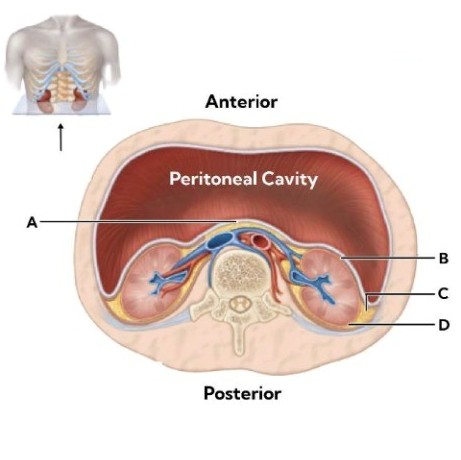 A)AB)BC)CD)D
- Identify the following structures by letter and make sure to number your answer for grading. Minor calyx ▾ I Renal medulla ▾ E Renal cortex ▾ EDropdown 1:Option 1: AOption 2: BOption 3: COption 4: IOption 5: EOption 6: FOption 7: GOption 8: HDropdown 2:Option 1: AOption 2: BOption 3: COption 4: DOption 5: EOption 6: FOption 7: GOption 8: HDropdown 3:Option 1: AOption 2: BOption 3: COption 4: DOption 5: EOption 6: FOption 7: GOption 8: H
- Identify the part of the organ that corresponds with the statement. The innermost part of the kidney, containing the renal pyramids and involved in concentrating urine. ▾ BDropdown 1:Option 1: AOption 2: BOption 3: COption 4: DOption 5: EOption 6: FOption 7: GOption 8: H
- Identify the following structures. Renal artery ▾ G Interlobar vein ▾ A Cortical radiate vein ▾ EDropdown 1:Option 1: AOption 2: BOption 3: COption 4: DOption 5: EOption 6: FOption 7: GOption 8: HDropdown 2:Option 1: AOption 2: BOption 3: COption 4: DOption 5: EOption 6: FOption 7: GOption 8: HDropdown 3:Option 1: AOption 2: BOption 3: COption 4: DOption 5: EOption 6: FOption 7: GOption 8: I
Exam Review
- Which of the following has the blood vessels listed out of order?A)Interlobar artery → Arcuate artery → Cortical radiate arteryB)Arcuate artery → Cortical radiate artery → Afferent arteryC)Renal vein→ Interlobar vein→ Arcuate veinD)Renal artery → Segmental artery → Interlobar arteryE)Afferent arteriole→ Glomerulus → Efferent arterioles
- What type of muscle is found in the muscularis layer of the ureters?A)Smooth muscleB)Cardiac muscleC)Skeletal muscleD)Mixed muscleE)Transitional muscle
- Identify the following structures. Internal urethral sphincter ▾ D Peritoneum ▾ A External urethral sphincter ▾ EDropdown 1:Option 1: AOption 2: BOption 3: COption 4: DOption 5: EOption 6: FOption 7: GOption 8: HDropdown 2:Option 1: AOption 2: BOption 3: COption 4: DOption 5: EOption 6: FOption 7: GOption 8: HDropdown 3:Option 1: AOption 2: BOption 3: COption 4: DOption 5: EOption 6: FOption 7: GOption 8: H
- What condition might a low specific gravity indicate?A)Diabetic ketoacidosisB)Urinary tract infection (UTI)C)DehydrationD)Presence of proteinE)Overhydration
Exam Review
- In the kidney filtration experiment, the results suggest that cells, proteins, and large molecules were too large to diffuse through the semi-permeable membrane.A)TrueB)False
- The kidneys are located on the ventral side of the body in the superior lumbar region.A)TrueB)False
- The peritubular capillaries surround the renal tubules in the cortex and are associated with cortical nephrons.A)TrueB)False
- The trigone of the bladder is formed by the two ureteric orifices and the internal urethral opening.A)TrueB)False
Exam Review
- . A patient's urine is cloudy and contains sediment. Does this indicate a normal or abnormal urinalysis?A)AbnormalB)Normal
- A patient had a urinalysis completed and pH was checked. Is the pH as indicated by the strip of paper to the right of the chart indicative of a normal pH?A)Yes, a urine pH of 5 is normal because it is within the range of 4.6-8.0.B)No, a urine pH of 9 is abnormal because it exceeds the normal range of 4.6-8.0.C)A urine pH of 6 is within the normal range because the normal pH range is 4.6-8.0.D)Yes, a urine pH of 7.4 is normal because it falls within the normal range of 7.35-7.45.E)No, a urine pH of 3 is abnormal because it is below the normal pH range of 4.6-8.0.
- Above is the result of a patient's urinalysis that looks for protein and glucose in the urine. The dip stick on the left is a control to show what a normal sample looks like. The dip stick on the right is the patient's result. How can this test be interpreted?A)The patient's test is normal for glucose, but positive for protein indicating diabetes.B)The patient's test is normal for protein, but positive for glucose indicating diabetes.C)The patient's test is positive for both glucose and protein in the urineD)The patient's test is normal for glucose, but positive for protein indicating kidney disease.E)The patient's test is normal for protein, but positive for glucose indicating kidney disease.F)The patient's test is the same as the control, so the patient does not have protein or glucose in their urine.
- From the glomerulus blood flows into the:A)Afferent arterioleB)Efferent arterioleC)Interlobar veinD)Arcuate veinE)Peritubular capillaries
Exam Review
- Four to five dropdown merge together to form a major calyx in the kidney.
- The function unit of the kidney called dropdown, produce urine, which travels through the collecting ducts, minor/major calyces, to the renal pelvis and ureters.
- The part of the male urethra that passes through the penis called the dropdown urethra.
- Of the approximately 180 L of fluid filtered by the kidneys each day, less than dropdown becomes urine.
Exam Review
- The glomerulus is a cluster of smooth muscle fibers that help push filtrate into the renal tubule.A)TrueB)False
- The glomerulus is situated between the arteriole and the efferent arteriole.A)DescendingB)ProximalC)DistalD)Afferent
- The basement membrane is composed primarily of glycoproteins andA)ElastinB)PhospholipidsC)Collagen fibersD)Myosin
- dropdown mesangial cells, found in the JGA, contract and relax to influence the glomerular filtration rate.