Exam Review
- A risk associated with IV push medication administration is?A)increased risk for speed shockB)Increased risk for infiltrationC)Increased risk for infectionD)A slow drug response
- Order: Aminophyllin 25 mg PO q 8h Recommended: 3-6 mg/kg/day in divided doses q 8h Child's Weight: 35 pounds Available: Aminophyllin 125 mg/5ml What is the minimum recommended daily dose for this child?A)4.7 mg PO-9.5 mg POB)47.7 mg PO-95.4 mg POC)5.9 mg PO-11.9 mg POD)15.9 mg PO-31.8 mg PO
- Order: Digoxin (Lanoxin) elixir 0.06 mg q 12 h PO Recommended: (under 2years of age) 0.01 to 0.02 mg/kg/day, in divided doses q12 h Child's weight: 20 pound, 11 month-old child Available Lanoxin elixir 0.05 mg per ml. What is the minimum and maximum safe and effective single dose for this child? (to the nearest hundredth)A)0.5 mg PO - 1.0 mg POB)1.5 mg PO - 3.2 mg POC)5.0 mg PO - 10 mg POD)0.05 mg PO-0.09 mg PO
- Child weight: 66 pounds What is the minimum and maximum amount of milligrams of Ampicillin that the patient should receive per dose?A)187.5 mg IM-375 mg IMB)125 mg IM-600 mg IMC)750 mg IM- 1500 mg IMD)2500 mg IM - 3000 mg IM
Exam Review
- What is the resulting dosage strength after reconstitution? Check to make sure that you labeled all answers as to unit of measurement and route. Order: Amoxicillin 125 mg PO q 8h (Refer to medication label)Correct Answer:125 mg/5 mL PO
- What type of diluent will you use to reconstitute this drug? Order: Amoxicillin 125 mg PO q 8h (Refer to medication label) Child's Weight: 27.5 pounds
A 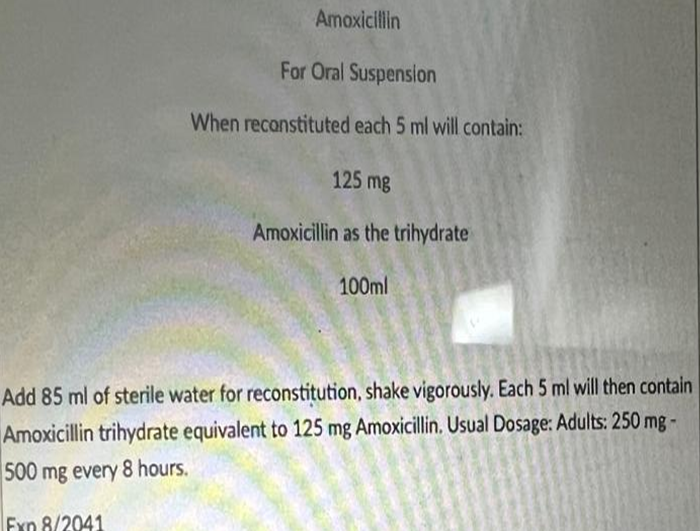
- A patient has a continuously running peripheral intravenous (IV) infusion. The physician orders the addition of an antibiotic as a piggyback infusion 4 times a day. What should the nurse do in order to administer the antibiotic safely?A)Start a new IV access to avoid compatibility issues with the new antibiotic.B)Start a new IV access to avoid too much volume at one IV site.C)Increase the continuous infusion to facilitate administration of the antibiotic.D)Check if the antibiotic is compatible with the continuous infusion solution.
- A risk for physical drug incompatibilities when the patient has a saline lock is reduced when.A)The nurse reconstitutes the drug.B)All IV medications are filtered with a 0.2-micron filterC)The IV catheter is flushed with 0.9% saline between drug infusions.D)The IV catheter is flushed with 5% dextrose in water between drug infusions.
Exam Review
- The physician has ordered Tramadol 25 mg PO q6h. The nurse has available Toradol 10 mg PO tablets. The nurse will administer:A)NoneB)2.5 tablets POC)2 tablets POD)1 tablet PO
- How many ml of diluent must be added? Check to make sure that you labeled all answers as to unit of measurement and route.Correct Answer:85 mL
- When you are assess your patient's IV site, before giving an IV push medication, you note that it is slightly red, swollen, and tender to touch. What is the best action by the RN?A)Plan to restart the IV in another location after the medicationB)Restart the IV in another location before infusing the medication.C)Change the IV dressing, it may be too tight.D)Infuse the medication slowly to decrease vein irritation.
- Order: Aminophyllin 25 mg po q 8h Recommended: 3-6 mg/kg/day in divided doses q 8h Child's Weight: 35 pounds Available: Aminophyllin 125 mg/5ml Based on the ordered amount and what you have available, how many ml will you give this child for a single dose?A)1 ml POB)25 ml POC)0.1 ml POD)0.2 ml PO
Exam Review
- Medication errors occur more frequently in the pediatric population due to:A)Availability of different dosage forms of the same medication.B)There are many standardized dosing regimens for children.C)Children are able to communicate adverse reactions.D)There is not a variance among children in body weight, surface area, and organ maturity.
- A postoperative patient has an IV saline lock in place. During assessment, the patient reports pain at 6 on a 0-10 scale. The nurse notes the following order for the patient Physician Order: Morphine Sulfate 6-8mg every 4 hours PRN for pain. Given the order and the patient's condition, which action should the nurse take?A)Administer 8 mg IVB)Administer 6 mg IVC)Administer 7mg IVD)Contact the Physician
- Order: 1500 ml D5W to be given IV over 10 hours Drop Factor: 15gtt/ml How many drops per minute?A)38 gtt/minB)40 gtt/minC)150 gtt/minD)6 gtt/min
- Ordered: Theophylline 3 mg/kg of body weight to be given q 6hr orally Recommended: 3 mg per kg per dose given four times per day Child's weight 42lbs Available: Theophylline 150 mg/15ml How many milliliters per dose? (to nearest tenth)A)5.7ml POB)0.4 ml POC)22.8 ml POD)1.9 ml PO
Exam Review
- Order: Aminophyllin 25 mg PO q8h Recommended: 3-6 mg/kg/day in divided doses q 8h Child's Weight: 35 pounds Available: Aminophyllin 125 mg/5ml What is the recommended range for this child for a single dose?A)15.9 mg to 31.8 mg POB)47.7 mg to 95.4 mg POC)1.6 mg to 3.2 mg POD)5.3 mg to 2.7 mg PO
- Based on your resulting solution strength, how many ml of Amoxicillin will you give to administer the ordered dose? Check to make sure that you labeled all answers as to unit of measurement and route. Order: Amoxicillin 125mg PO q 8hrs
- How many milliliters will the child receive per dose? (round to the nearest hundredth) and choose the correct syringe you would administer your dose with (refer to your previous answer)A)0.5ml syringeB)1ml syringeC)3 ml syringeD)5ml syringe
- Order: Digoxin (Lanoxin) elixir 0.06 mg q 12 h PO Recommended: (under 2years of age) 0.01 to 0.02 mg/kg/day, in divided doses q 12 h Child's weight: 20 pound, 11 month-old child Available: Lanoxin elixir 0.05 mg per ml Per doctor's order, how many milliliters should be administered to this child per dose?A)1.2 ml POB)0.06 ml POC)0.05 ml POD)1.6 ml PO