Exam Review
- Exhibits (Highlight — findings requiring follow-up are marked)Exhibits
Click to highlight the findings that require follow up.
Neurological: Alert and oriented person, place, time, and situation Agitated. Denies headaches.
Cardiovascular: Reported chest pain described as pressure and tightness that is unrelieved with rest. Rapid regular rhythm. Normal heart tones. Radial and pedal pulses 2+. Capillary refill 2 seconds.
Respiratory: Rapid and shallow breaths. Clear breath sounds throughout bilateral lungs.
Gastrointestinal: Within normal limits (WNL).
Genitourinary: WNL.
Musculoskeletal M/MIL
Pain: Reported 7 on a 0 to 10 scale, tightness and pressure in chest. Started approximately 2 hours ago and got progressively worse, unrelieved by rest.
- A 57-year-old male client is brought to the emergency department (ED) by emergency medical services (EMS) with reports of chest pain. Client was mowing his lawn and noticed chest pain presenting as tightness and pressure. The pain continued to increase over about 30 minutes when the client decided to rest. The client's wife called emergency medical services (EMS) when the pain was unrelieved after 20 minutes of rest. Client reports no other incidents of experiencing this pain. His medical history includes hypertension, obesity, and a 20 year history of smoking, having quit about 5 years ago. Takes metoprolol succinate ER 25 mg PO. Exhibits For each assessment finding, click to specify if the finding is consistent with angina or myocardial infarction, or both. Each column must have at least one response option selected.
myocardial infarction Angina Epigastric distress ✓ ✓ Occurring without cause ✓ Pain only relieved by opioids ✓ Feelings of fear ✓ ✓ Chest pain radiating down arm ✓ ✓ Pain relived by nitroglycerin ✓ - Exhibits Initial testing is complete, and the nurse is reviewing the results. Choose the most likely options for the information missing from the statement by selecting from the lists of options provided. The nurse determines that the client has▾ new onset angina as evidenced by ST depression on electrocardiogram and normal ▾ troponinlevel.Dropdown 1:Option 1: ST elevation myocardial infarctionOption 2: new onset anginaOption 3: Chronic stable anginaDropdown 2:Option 1: troponinOption 2: prothrombinOption 3: INR
- Exhibits Drag and drop word choices to complete the sentence. If healthcare providers (HCPs) see a narrowed heart vessel while performing a percutaneous coronary intervention (PCI), they may perform a balloon angioplasty to compress the plaque against the vessel wall and hold it there with a stent, which will lessen ▾ painand▾ Dysrhythmias.Dropdown 1:Option 1: DysrhythmiasOption 2: heart blocksOption 3: painOption 4: palpitationsOption 5: shortness of breathDropdown 2:Option 1: DysrhythmiasOption 2: heart blocksOption 3: painOption 4: palpitationsOption 5: shortness of breath
Exam Review
- Exhibits For each medication, choose the drug classification and medication action.
Calcium channel blocker Antiplatelet Angiotensin-converting enzyme inhibitor Nitrate Amlodipine ✓ Aspirin ✓ Lisinopril ✓ Nitroglycerin ✓ - Exhibits Which 2 statements from the client should the nurse recognize as a need for further education?(SATA)A)I will keep my nitroglycerin tablets with me all the time.B)I will chew my nitroglycerin tabs as soon as pain begins.C)I will call 911 if there is no improvement in my chest pain after taking nitroglycerin.D)I will take the nitroglycerin 1 or 2 more times 10 minutes apart if pain does not get better.E)I will wait 5 minutes after taking my nitroglycerin to see if the pain improves.F)I will lie down or sit if I start to feel any chest discomfort.G)I will wear a medication alert bracelet to indicate my history of heart problems.
- The nurse is monitoring the client's cardiac rhythm. Based on this strip, which is the correct interpretation of this rhythm?
A 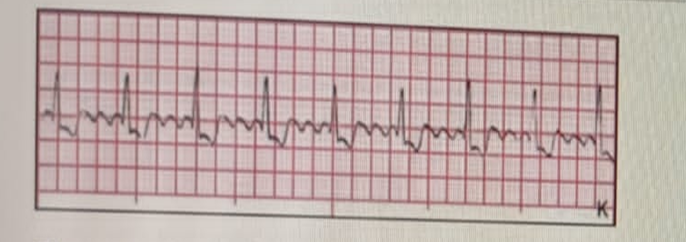 A)Atrial flutter.B)Normal sinus rhythm.C)Sinus arrhythmia.D)Atrial fibrillation.
- A client collapses while ambulating in the hallway. The nurse calls for help after verifying that the client is not breathing and has no palpable pulse. Which intervention should the nurse implement?A)Begin chest compressions at a depth of at least 2 in (5.1 cm).B)Perform forceful sternal rub to check for unresponsiveness.C)Assess the client for any obvious injuries due to the sudden fall.D)Remove the client's clothes and apply automated external defibrillator (AED) pads to chest.
Exam Review
- When conducting discharge teaching for a client who has had a mechanical valve replacement, which information should the nurse plan to include?A)It will no longer be necessary to take daily doses of anticoagulants.B)The client will need to take an antibiotic before dental procedures.C)Mechanical valves usually must be replaced within 7 to 10 years after insertion.D)Heparin injections will be required to decrease the incidence of clot formation.
- Exhibits The nurse reviews chart data. Complete the diagram by dragging from the choices area which potential condition the client is experiencing, two actions to take, and two parameters the nurse would monitor.✓Draw laboratory cardiac markers✓Insert two peripheral IV (PIV) access devices✓Myocardial infarction (MI)✓Pain level✓12-lead electrocardiogram (ECG)Actions to Take Choices✓Draw laboratory cardiac markers✓Insert two peripheral IV (PIV) access devices✕Insert nasogastric tube (NGT) for nutritional intake✕Consult nutritionist✕Begin strict bedrestPotential Conditions Choices✕Reflux✕Costochondritis✓Myocardial infarction (MI)✕Atrial fibrillation (A-fib)Parameters to Monitor Choices✓Pain level✕Intake and output✓12-lead electrocardiogram (ECG)✕Nutritional intake✕Peripheral edema
- A client recovering from cardiac surgery experiences a dysrhythmia, noted on the telemetry monitor. Which assessment finding is most likely to have contributed to the development of the dysrhythmia? Reference Range: Total Calcium [8.4 to 10.6 mg/dL (2.10 to 2.50 mmol/L)] Sodium [136 to 145 mEq/L (136 to 145 mmol/L)] Potassium (K+) [3.5 to 5.0 mEq/L (3.5 to 5.0 mmol/L)]A)Potassium level 3.8 mg/dL (3.8 mmol/L).B)Sodium level 140 mEq/L (140 mmol/L).C)Oxygen saturation level 97%.D)Calcium level 7.2 mg/dL (1.8 mmol/L).
- An older adult client comes to the emergency department stating, "My heart is beating out of my chest." Based on this electrocardiogram (ECG) rhythm strip, which intervention should the nurse implement?A)Assess oxygenation status.B)Administer IV atropine.C)Prepare for a transcutaneous pacemaker.D)Administer IV heparin infusion.
Exam Review
- The nurse at a primary healthcare provider's (HCPs) office is assessing a middle aged client who describes having symptoms of angina pectoris that occured while doing yard work. Which additional finding should the nurse obtain?A)A description of the chest pain when client is at rest.B)A demonstration of the activity that precipitates pain.C)A complete seven (7) day diet history of client's oral intake.D)The client's blood pressures sitting and standing.
- The nurse auscultates a client's heart sounds and hears a midsystolic click associated with mitral valve prolapse. Which diagnostic test should the nurse prepare the client to expect the healthcare provider (HCP) to prescribe?A)Troponin and creatine kinase-myocardial band (CK-MB) levels.B)Computed tomography (CT) scan of the chest.C)2D-echocardiography.D)12-lead electrocardiogram (ECG).
- A client's radial heart rate suddenly increases from 82 to 112 beats/minute with a 1+ pulse volume. Which assessment should the nurse complete next?A)Urinary output.B)Pedal pulses.C)Heart sounds.D)Blood pressure.
- The nurse is caring for a client recovering from a recent myocardial infarction. To reduce cardiac workload, which intervention should the nurse include in the client's plan of care?A)Assist with ambulation in the hallway.B)Provide a bedside commode for toileting.C)Encourage active range of motion exercise.D)Teach to sleep in a side-lying position.
Exam Review
- A male client with angina pectoris is being discharged from the hospital. Which instruction should the nurse plan to include in his discharge teaching?A)Keep nitroglycerin in a light-colored plastic bottle and readily available.B)Avoid isometric exercises, but walk regularly.C)Walk briskly in cold weather to increase cardiac output.D)Engage in physical exercise immediately after eating to help decrease cholesterol levels.
- An older adult male client is admitted after three reported syncopal episodes at home. He has several bruises at various stages of healing noted over his arms and legs. The cardiac monitor shows atrial fibrillation (A-fib) with a ventricular response of 140 beats/minute. In addition to contacting the client's healthcare provider (HCP), which intervention should the nurse implement?A)Contact the client's healthcare power of attorney.B)Call for immediate help from the rapid response team (RRT).C)Report the client's falls and bruises to adult protective services.D)Monitor the client's blood pressure and oxygen saturation.
- Exhibits Review H and P, nurse's notes, flow sheet, prescriptions, and imaging studies. Complete the diagram by dragging from the choices area to specify which condition the client is most likely experiencing, two actions the nurse should take to address that condition, and two parameters the nurse should monitor to assess the client's progress.
- A client who had a percutaneous coronary intervention (PCI) two weeks ago returns to the clinic for a follow up visit. The client has a postoperative ejection fraction of 30%. Today the client has lungs which are clear, +1 pedal edema, and a 5 pound weight gain. Which intervention should the nurse implement?A)Instruct the client to monitor daily caloric intake.B)Assess compliance with routine prescriptions.C)Arrange transport for admission to the hospital.D)Insert saline lock for IV diuretic therapy.
Exam Review
- The nurse is caring for an older adult client with heart failure (HF) whose arterial blood gas (ABG) results include a pH 7.38, PaCO2 40 mm Hg, HCO3- 24 mEq/L (24 mmol/L), and a PaO2 90 mm Hg. Which action should the nurse implement? Reference Range: Arterial Blood Gas (ABG) pH [7.35 to 7.45] PaCO2 [35 to 45 mm Hg] HCO3- [21 to 28 mEq/L (21 to 28 mmol/L)] PaO2 [80 to 100 mm Hg]A)Continue to monitor the client's condition.B)Encourage the client to cough and deep breathe.C)Administer oxygen per face mask per PRN protocol.D)Instruct the client to breathe into a paper bag.
- Following a mitral valve replacement, the client suddenly begins to show a large amount of blood on the surgical dressing while in the postanesthesia care unit (PACU). Which intervention should the nurse implement first?A)Apply topical fibrin directly to the incision.B)Reinforce the incisional dressing.C)Increase the intravenous fluid rate.D)Obtain samples for coagulation studies.
- The nurse is assessing a client with a history of deep vein thrombosis (DVT) who is admitted for possible pulmonary embolism (PE). It is important to report which finding to the healthcare provider immediately?A)Unilateral calf pain.B)Intravenous site inflammation.C)Pedal edema.D)Difficulty breathing.
- While assessing a client with type 2 diabetes mellitus (DM), the nurse observes an absence of hair growth on the client's lower legs. Which assessment provides further data to support this finding?A)Presence of bilateral femoral pulses.B)Signs of old and new ecchymosis.C)Altered posture and balance during ambulation.D)Appearance of the skin on the client's legs.