Exam Review
- A 39 week and 2 day client is currently in the second stage of labor. The nurse is explaining to the client and support partner what is seen on the external fetal monitor. What deceleration pattern is a normal finding in the second stage of labor.A)Early deceleration indicative of fetal increased intracranial pressure.B)Present decelerations indicative of passage through the cervix.C)Absent deceleration indicative of good fetal movement.D)Variable deceleration indicative of umbilical cord compression.
- Immediately following an epidural block, a client's blood pressure falls to 90/50. Which priority action would the nurse take.A)Administer Oxytocin.B)Administer 6 liters of Oxygen via face mask.C)Turn client on their left side and increase intravenous fluids.D)Raise the head of the bed and elevate the patient's legs.
- The nurse is creating a care plan for an intrapartum client at the end of the third stage of labor. What is the desired outcome for the client.A)Firmly contracted uterine fundus.B)Efficient fetal heart beat variability.C)Absence of discomfort.D)Maternal respiratory rate within expected range.
- What are presumptive signs of pregnancy that the nurse would expect when assessing a client at 10 weeks gestation. Select all that apply.(SATA)A)Abdominal enlargement.B)Breast changes.C)Positive urine pregnancy test.D)Goodell sign.E)Fetal heart tones.F)Urinary frequency.G)Amenorrhea.
Exam Review
- An amniotomy is performed on a laboring client at 42 weeks' gestation. What priority intervention should the nurse perform.A)Assessing the characteristics of the amniotic fluid.B)Monitoring the client for signs of infection.C)Inspecting the perineum for bloody discharge.D)Checking the fetal heart rate.
- A 38 week primipara client comes into the clinic for a cervical check and an external monitor is placed on the client's abdomen. Based on the following strip how would the nurse document the fetal heart rate.
A 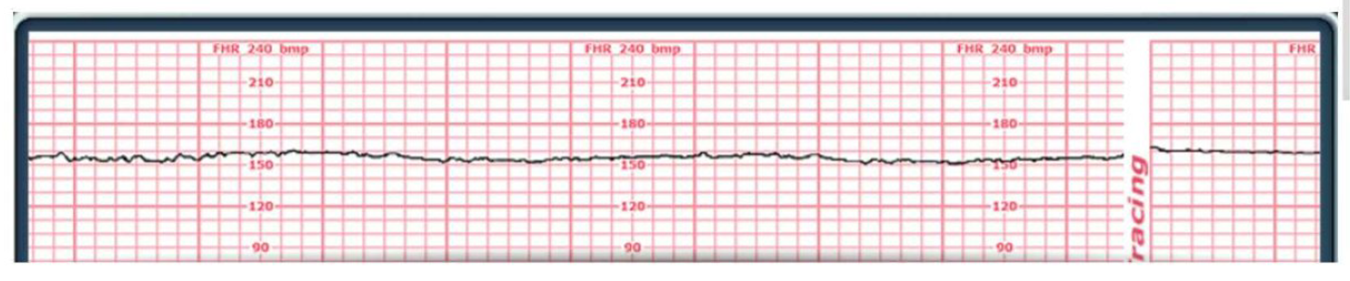 A)Normal baseline, Absent variability, Present accelerations, Variable decelerations.B)Normal baseline, Present variability, Absent accelerations and Absent decelerations.C)Normal baseline, Minimal variability, Absent accelerations, and Absent decelerations.D)Normal baseline, Moderate variability, Present accelerations, Early decelerations.
- A client who believes they are pregnant is informing the nurse of their pregnancy signs and symptoms. Which assessment finding would the nurse determine is a presumptive sign of pregnancy?A)Hegar's sign.B)Quickening.C)Chadwick sign.D)Positive pregnancy test.
- A nurse is creating the plan of care for a client who is at 39 weeks of gestation and in labor. A vaginal exam reveals that the client's cervix is 3 cm dilated, 50A)Offer the client the option to start epidural anesthesia.B)Encourage use of non-pharmacologic alternative comfort measures.C)Administer narcotic analgesia per standing orders.D)Offer the client ice chips and breakfast.
Exam Review
- A nurse is caring for a client during a nonstress test (NST). At the end of a 20-minute period of observation, the nurse noted the following findings: The fetal heart rate baseline is 120 beats per minute with no decelerations. There are two accelerations increasing the fetal heart rate by 15 beats above the baseline during a period of fetal movement, each lasting 20 seconds. What reason would the nurse provide to explain to the pregnant client a reactive test?A)Maternal uterine contractions.B)Fetal gestational age.C)Fetal physical activity.D)Maternal blood pressure.
- A 37-week client is stating she is having severe back pain and is placed on an external monitor. The monitor shows the following fetal and contraction tracing. How would the nurse document the client's contractions?
A 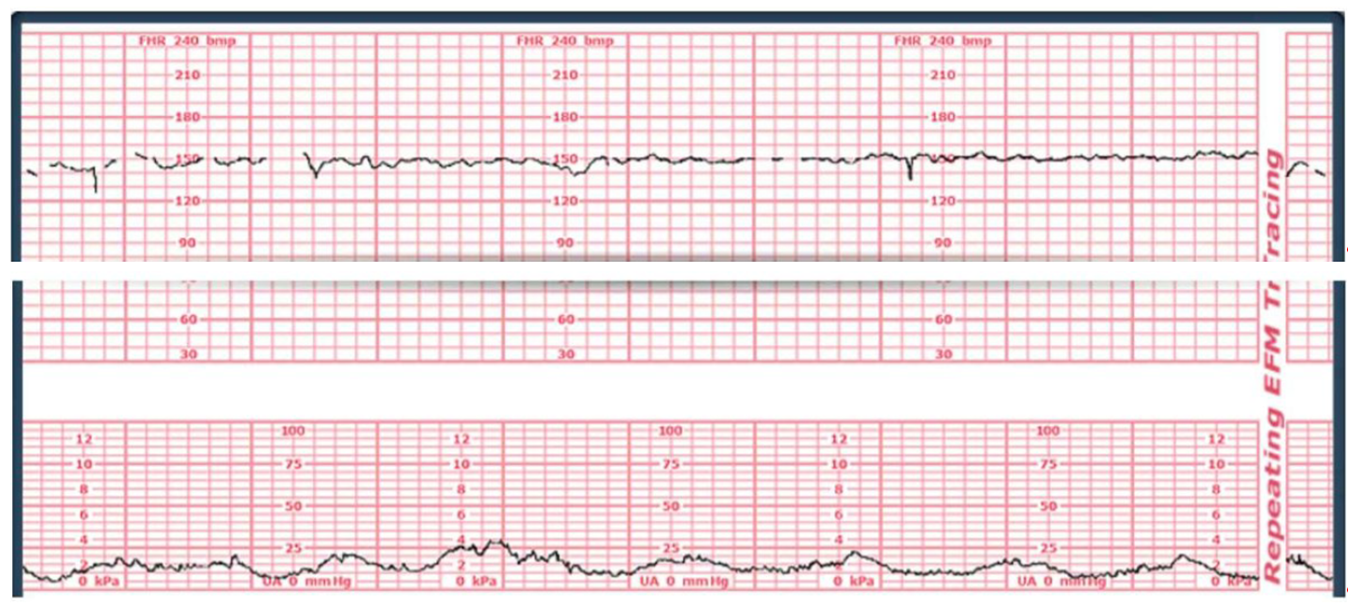 A)Indeterminate.B)Tachysystole.C)Normal.D)Bradycardia.
- A postpartum client required an extensive episiotomy because her newborn had macrosomia. Which nursing intervention will minimize edema and lessen discomfort associated with the episiotomy?A)Administering an intravenous analgesic to the client.B)Positioning the client with pressure on the perineum.C)Applying ice packs to the perineum.D)Spraying the perineum with a local anesthetic.
- The nurse is teaching a group of clients in a prenatal education class. What statement by a pregnant client indicates the need for additional teaching?A)During pregnancy it's safe for me to use my regular herbal remedies.B)My doctor will tell me if it's safe to take my allergy medications.C)I'm only 10 weeks pregnant, so I should continue taking folic acid.D)I should avoid all x-rays unless absolutely necessary and tell them I'm pregnant.
Exam Review
- The nurse is teaching a group of clients in a prenatal education class. Which of the following exercises would the nurse recommend for the client to perform?A)Half sit-ups.B)Pelvic tilt.C)Pelvic rocking.D)Kegel exercises.
- A client is receiving an epidural anesthesia of Bupivacaine during labor. Which alteration would the nurse monitor for in the client?A)Decreased level of consciousness.B)Hypothermia.C)Hypertension.D)Urinary retention.
- The nurse is giving report to a student about a newborn they suspect has toxoplasmosis. Which statement by the student on how and when the infection was transmitted to the newborn does not require further teaching?A)Through a prolonged rupture of membranes.B)In the postpartum period through infected droplets.C)During birth as the fetus was expelled through the vaginal canal.D)In utero through the placenta.
- During the postpartum period, a client with heart disease and type 2 diabetes asks the nurse, "Which contraceptive will I be able to use to prevent pregnancy in the near future?". What is the best response by the nurse?A)You have little to worry about regarding becoming pregnant in the near future, because of your illness.B)You should use foam with a condom to prevent pregnancy; this is the safest method.C)You may use oral hormonal contraceptives; they are very effective in preventing pregnancy.D)The intrauterine device may be a good choice because of its high effectiveness and ease of use.
Exam Review
- A 20-year-old woman, who presents to the sexual health clinic, is concerned because approximately 7 days following intercourse with a new partner, several painful genital lesions appeared. Before the lesions appeared, she states that she had a "cold" and fever. She describes them as looking like a "blister" and notes that some have ruptured and crusted over. She is worried that her partner may have given her a sexually transmitted infection (STI) and is expressing feelings of anger. Based on the patient's presentation, which potential condition should the nurse suspect?A)Syphilis.B)Chlamydia.C)Genital herpes.D)Human papillomavirus (HPV).
- A 20-year-old woman presents to the sexual health clinic. Her history includes trichomoniasis and irregular menses. Her last menstrual period began 4 days ago. She states that her periods are heavy and last between 2 and 9 days. She has an intrauterine device (IUD) in place for birth control, and she does not wish to change her current method of birth control. She is on an antidepressant. On arrival, her blood pressure is 108/74 mmHg, pulse 75 bpm, respiratory rate 18 breaths/min, and temperature 98.2°F (36.8°C). She is 5'7" (170 cm) and weighs 190 pounds (86 kg) (BMI 29.75 kg/m). The client is waiting to be evaluated by the healthcare provider, and the nurse is conducting a detailed health history. Which aspect of the client's history requires further investigation by the nurse?A)The use of an antidepressant medication.B)The client's history of irregular menses.C)The client's blood pressure of 108/74 mmHg.D)The client's current weight and BMI status.
- The fetal monitor demonstrates a pattern that reflects uteroplacental insufficiency. What is the priority action by the labor nurse?A)Move the client to the operating room for a cesarean.B)Administer oxygen via face mask to the client.C)Turn the client or ask the client to turn to their left side.D)Increase the client's intravenous Lactated Ringer's.
- The nurse is caring for a client with preterm labor whose provider orders tocolytic therapy. Which clinical findings indicate a desired outcome from tocolytic therapy?A)Contractions occurring occasionally and lasting for 30 seconds every 2 minutes.B)Fetal Heart Rate (FHR) 170 beats per minute (bpm) with a decrease from moderate to minimal variability.C)FHR 140 bpm with minimal variability with late decelerations.D)Contractions slowing with a fetal heart rate of 130 bpm and moderate variability.
Exam Review
- The healthcare provider ordered 500 mL D5W with 10 units of oxytocin to begin at 2 mU/min and then increase by 1 mU/min every 30 minutes until regular uterine contractions begin. The maximum dose is 30 mU/min. What is the infusion flow rate for the beginning infusion? Round to the nearest whole number.
- A pregnant client asks the nurse the purpose of the maternal serum alpha-fetoprotein (MSAFP) test. How would the nurse respond?A)It measures maternal liver function.B)It is a screening test for placental function.C)It tests the ability of her heart to accommodate the pregnancy.D)It is a screening test for neural tube defects.
- A 40 week primipara client is currently being monitored by external fetal monitoring. The monitor alerts for an ominous sign of fetal hypoxia. The nurse is assessing the strip. Based on the following strip, how would the nurse document the fetal heart rate?A)Bradycardia, Moderate variability, Present accelerations, Late decelerations.B)Normal baseline, Moderate variability, Absent accelerations, Early decelerations.C)Normal baseline, Minimal variability, Present accelerations, Early decelerations.D)Normal baseline, Minimal variability, Absent accelerations, Late decelerations.
- A client arrives to the prenatal clinic for their first prenatal assessment. They tell the nurse that the first day of their last menstrual period (LMP) was April 19, 2024. Using Naegele's rule, the nurse informs the client that their estimated date of delivery is which date? Please record answer as MM/DD/YYYY.A)01/25/2025B)01/26/2025C)01/27/2025D)01/24/2025