Exam Review
- The nurse is caring for a child admitted with head trauma after falling off of a swing. Which early assessment finding would alert the nurse to possible increased ICP in the child?A)BradycardiaB)Restlessness and confusionC)Large amounts of very dilute urineD)Widened pulse pressure
- Which is the most developmentally appropriate intervention when working with the hospitalized adolescent?A)Encourage peers to call and visit when the adolescent's condition allowsB)Ask the parents how the adolescent usually copes in new situationsC)Discourage questions and concerns about the effects of the illness on the adolescent's appearanceD)Be sure the adolescent wears a hospital gown or pajamas throughout the hospitalization
- A HIV+ mother is presenting to the primary care office with her newborn. She wants more information about breastfeeding her child, which of the following responses from the nurse BEST answers the mother's question?A)You cannot breastfeed your child, let me provide you with formula options.B)Breastfeeding is possible and you really only need to test the infant once after you begin to ensure HIV was not transmitted to the child.C)Breastfeeding is possible if you are taking your ART and we frequently test you and your baby for HIV RNA.D)You can breastfeed your child but it will be very stressful and high risk. Please consider formula.
- A child with diabetes reports that he is feeling a little shaky. Further assessment reveals that the child is coherent but with some slight tremors and sweating. A fingerstick blood glucose level is 70 mg/dL. What would the nurse do next?A)Offer a complex carbohydrate snackB)Give 10 to 15 grams of a simple carbohydrate.C)Administer glucagon intramuscularly.D)Administer a sliding-scale dose of insulin.
Exam Review
- The nurse is presenting an information session on birth defect prevention. What supplement should be recommended to decrease the incidence of neural tube defects?A)Folic acidB)Vitamin DC)IronD)Calcium
- The nurse is caring for a child in respiratory distress who is experiencing substernal retractions. Select the red area where SUBSTERNAL retractions occur.
A 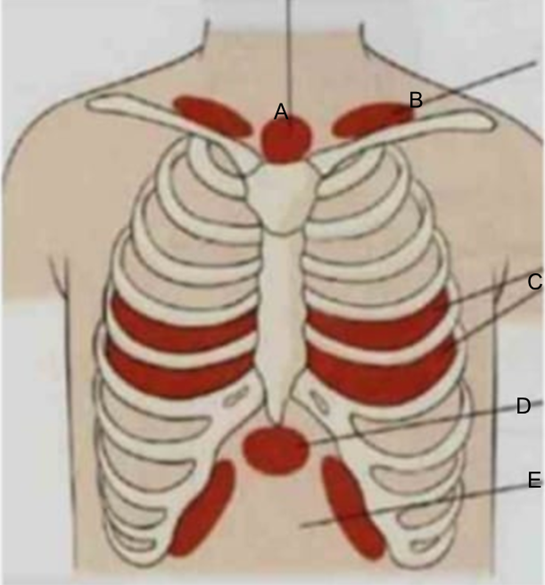 A)AB)BC)CD)DE)E
- The nurse on the pediatric floor is taking care of a patient just diagnosed with Kawasaki Disease. On exam, the nurse can expect to find this hallmark clinical finding ▾ Cracked Lips and Strawberry tongue.: and to administer these medications: ▾ Aspirin and IV Gamma Globulin.Dropdown 1:Option 1: Petechiae and Purpura rashOption 2: Cracked Lips and Strawberry tongue.Option 3: Polyarthritis and ChoreaDropdown 2:Option 1: Aspirin and IV Gamma GlobulinOption 2: Corticosteroids and AntibioticsOption 3: ACE inhibitors and NSAIDS.
- During a routine well child visit, the parent of a 10-year-old child tells the nurse. "My child doesn't want my help with anything anymore." What is the best response from the nurse?A)"Let your child know that (s)he should inform you when (s)he needs to have something done"B)"Children of this age need to learn to solve problems and assume more responsibility for themselves"C)"Just let your child know you are the parent, and that what you are doing is the right thing"D)"Continue to do what you have been doing for your child. Ten is too young for children to make any decisions for themselves”
Exam Review
- Classify the following congenital cardiac defects as cyanotic defects or cyanotic defects.
Cyanotic Acyanotic Hypoplastic Left Heart Syndrome ✓ Transposition of the Great Arteries ✓ Atrial Septal Defect ✓ Coarctation of the Aorta ✓ Patent Ductus Arteriosus ✓ Tetralogy of Fallot ✓ - You are calculating the intake for a 10 month old infant for the past 4 hours. She is on a clear liquid diet in the past 4 hours she has taken 6.5 ounces of water from a sippy cup. She also ate an entire 2 ounce Pedialyte ice pop and 1/4 cup of jello. Her maintenance IV fluids are running at a rate of 18 ml/hr. She received a dose of Ceftriaxone 400mg/50ml via IV piggyback two hours ago. What is the total intake for this patient in the past 4 hours. Please put your answer in MILLILITERS and round to the nearest WHOLE number.Correct Answer:437 mL
- As the nurse you are explaining the treatment plan to an adolescent for their newly diagnosed Type 2 Diabetes. Which treatment options below are appropriate for Type 2 Diabetes? Select FOUR that applyA)Metformin twice a day, taken with food to prevent Gl upsetB)Long acting lantus before bed to control blood sugar overnightC)Rapid Acting Insulin dosed using a sliding scale before every mealD)Consistent aerobic exercise every day with a goal of 60 minutes per day.E)Regular blood sugar monitoring throughout the dayF)Use of a continuous subcutaneous insulin pump to control blood sugar.G)Well balanced diet and monitoring simple sugar intake
- A newborn with transposition of the great arteries, a life threatening cardiac defect, is being admitted to the unit. The nurse should anticipate an order to administerA)DigoxinB)Prostaglandin EC)FurosemideD)Indomethacin
Exam Review
- A nurse is conducting a class to a group of parents on sickle cell anemia. Which statement by a parent indicates teaching has been effective?A)"This is a hereditary disease that is transmitted by one affected gene."B)"Fluid restriction is necessary to control sickle cell anemia.C)"The sickle shape of red blood cells decreases oxygen to tissues."D)"Sickle cell anemia is common in people of Asian descent."
- A 14-year-old male child with sickle cell anemia is being discharged after treatment for a crisis. Which instructions for avoiding future crises should the nurse provide the child and family? Select the 3 that apply.A)Drink plenty of fluidsB)Restrict any physical activitiesC)Report a fever to an adult immediatelyD)Wash hands before meals and after playingE)Use cold pack to relieve joint pain
- A 10 year old boy is being started on growth hormone therapy for diagnosed growth hormone deficiency. The parents ask you if he will have to be on growth hormone injections for his whole life. The best response from the nurse is:A)"No, the endocrinologist will stop treatment when epiphyseal plates are closed."B)"No, the endocrinologist will stop treatment at the first signs of puberty."C)"Yes, since your son does not make growth hormone on his own he will need to continue this medication for life."D)"Yes, he will need this therapy for life, but the injections will get easier to administer as he gets older."
- Which of the following cardiac defects is NOT present in an infant presenting with Tetralogy of Fallot (TOF)?A)Overriding AortaB)Right Ventricular HypertrophyC)Left Ventricular aneurysmD)Pulmonic StenosisE)Ventricular Septal Defect
Exam Review
- At a 2 year old well child exam the nurse is giving anticipatory guidance related to prevention of accidental ingestions to the parents. Which statement by the parents demonstrates understanding.A)"I will place number for Poison Control on my refridgerator where it is easily visible, in case I need it."B)"I will lock up prescription medications so they are out of reach, but my vitamins are okay to keep in the kitchen since they cannot cause any harm."C)"If I suspect my child has ingested toxic substance I will not wait to get help. I will drive them to the ER immediately to be evaluated."D)"If I suspect my child has ingested a toxic substance, I will attempt to make them throw up, put them on their side and then call 911.
- A nurse is providing teaching to a parent of a child who has a fracture of an epiphyseal plate. Which of the following statements should the nurse make?A)"The blood supply to the bone is disrupted."B)"The younger the child, the longer the healing process will take."C)"Bone marrow can be lost through the fracture."D)"Normal bone growth can be affected."
- A 6-year-old child was diagnosed as having streptococcal pharyngitis. At the follow-up visit, the nurse will assess the child for which potential complication?A)development of rheumatic feverB)infection that may cause a tooth abscessC)nephrosis of the kidneyD)swollen lymph nodes that obstruct the airway
- A child with coarctation of the aorta will have dropdown pedal pulses and dropdown brachial pulses.
Exam Review
- A 15-year old adolescent is brought to the emergency department by his parents. The adolescent is febrile with chills that started suddenly. He states, "I had a sinus infection and sore throat a couple of days ago." The nurse suspects bacterial meningitis based on which findings? Select THREE that applyA)Right leg painB)RLQ abdominal pain 7/10C)Negative Brudzinski'sD)Severe HeadacheE)VomitingF)Photophobia
- Which of the symptoms below would alert the nurse that an infant may have a cardiac issue? Select the 3 that applyA)Diaphoresis while eatingB)Small stature for ageC)Poor social developmentD)Warm extremitiesE)Cyanosis
- A 2 week old patient in the NICU has a 'machine like murmur, poor growth and bounding pulses. He has been diagnosed with a Patent Ductus Arteriosus. What medication would the nurse anticipate administering to this patient?A)DigoxinB)ProstaglandinC)FurosemideD)Indomethacin
- The nurse is developing a teaching plan for the parents of a 12-year-old boy with cystic fibrosis. For which piece of equipment should the nurse prioritize education?A)Flutter valve deviceB)Peak Flow MeterC)NebulizerD)Metered-dose inhaler