Exam Review
- A nurse is collecting data from a client who underwent a thyroidectomy 4 hr ago. Which of the following client findings indicates a complication of the procedure?A)Tingling of the fingersB)Serosanguineous drainage on the dressingC)Soreness at the incision siteD)Report of sore throat
- A nurse is reinforcing teaching with a client who is to begin taking lansoprazole. Which of the following statements by the client indicates an understanding of the teaching?A)"I should report episodes of diarrhea."B)"I should expect the medication to cause indigestion."C)"I should take the medication following a meal."D)"I should chew the capsule thoroughly."
- A nurse is assisting in the care of a male client who has a new prescription for furosemide. Which of the following client findings should the nurse identify as a contraindication to the administration of furosemide? Select the 3 findings the nurse should identify as a contraindication.(SATA)A)Potassium levelB)Client verbal reportC)Blood pressureD)Prescription for digoxinE)BUN
- Which of the following client findings should the nurse identify as a contraindication to the administration of simvastatin? Select all that apply.(SATA)A)Blood pressureB)Creatinine kinaseC)BUND)Prescription for diltiazemE)Client report of muscle ache
Exam Review
- A nurse is reinforcing teaching with a client who is to undergo a bone marrow aspiration. Which of the following statements should the nurse include in the teaching?A)"I will hold pressure to the site after the procedure."B)"You will need to fast for 2 hours before the procedure."C)"You will not receive a local anesthetic agent for this procedure."D)"You will have the bone marrow taken from your femur."
- A nurse is caring for a client who is 2 days postoperative following abdominal surgery. The nurse auscultates hypoactive bowel sounds, and the client reports cramping abdominal pain. Which of the following actions should the nurse take first?A)Request the client to be NPO.B)Administer a glycerin suppository.C)Offer an analgesic medication.D)Ambulate the client in the hallway.
- A nurse is providing care for a client who has hemophilia and is bleeding from a small laceration on his arm. After applying a sterile dressing which of the following actions should the nurse take next?A)Obtain a radial pulse.B)Maintain direct pressure over the site.C)Reinforce the dressing over the site.D)Check whether the bleeding has stopped.
- A nurse is reinforcing teaching with a newly licensed nurse regarding the use of personal protective equipment when performing respiratory suctioning for a client who has community-acquired pneumonia. Which of the following statements by the newly licensed nurse indicates the need for further teaching?A)"I should limit my conversation with the client while wearing my mask."B)"After completing the suctioning. I should remove my gloves."C)"I will need to wear an N95 respiratory mask while suctioning the client."D)"I will pull the glove cuff over the wrist of the gown."
Exam Review
- A nurse is caring for a client who has a tracheostomy tube. Upon data collection, the nurse observes the client is restless and hears crackles in the lungs. Which of the following interventions should the nurse take?A)Perform suctioning.B)Instil saline into the tubing.C)Increase the humidification.D)Check the cuff pressure.
- A nurse is caring for a group of clients on a surgical unit. Which of the following images should the nurse identify as evisceration?
A 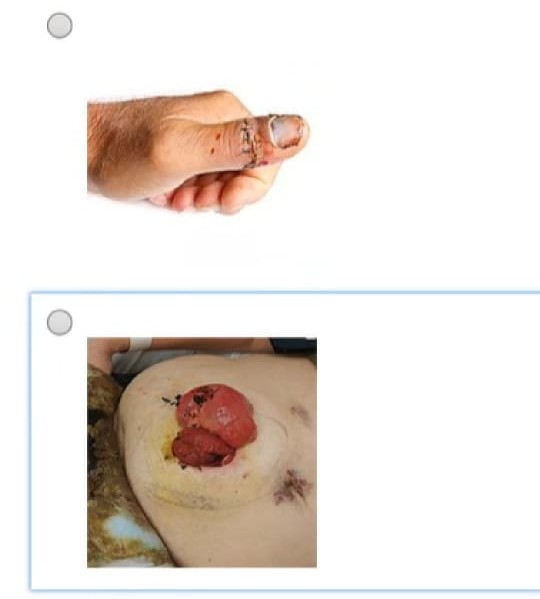 A)AB)B
- A nurse is reinforcing teaching with a client who has anemia and has a prescription for ferrous sulfate. Which of the following foods should the nurse recommend that the client consume to increase the absorption of this medication?A)CheeseB)Raw orangesC)OatmealD)Baked potatoes
- A nurse is transporting a client who has pneumonia and is on droplet precautions to radiology. Which of the following safety measures should the nurse take while transporting the client?A)The nurse should wear a mask during transport.B)The client should wear a gown during transport.C)The nurse should wear a gown during transport.D)The client should wear a mask during transport.
Exam Review
- A nurse is reinforcing bladder management instructions with a client who has urinary incontinence. Which of the following statements by the client indicates an understanding?A)"I should use the bathroom at set times during the day."B)"I can insert a catheter in my bladder at bedtime."C)"I should stop drinking fluids an hour before bedtime."D)"I can continue to drink coffee every day."
- A nurse is preparing to perform a blood glucose test. After performing hand hygiene and donning gloves, in which order should the nurse perform the following actions to obtain a capillary blood sample? (Move the steps into the box on the right, placing them in the order of performance. Use all the steps.)A)Pierce the puncture site quickly.B)Allow the site to dry.C)Cleanse the site with an antiseptic swab.D)Apply blood to the test strip.E)Squeeze the site gently to obtain a blood droplet.
- A nurse is caring for a client who is postoperative. For which of the following findings should the nurse suspect the client is experiencing a deep vein thrombosis?A)Absent pedal pulseB)Numbness of the affected extremityC)Warmth of the affected extremityD)Muscle spasms
- A nurse in an assisted living facility is collecting data from an older adult client who fell in their room and hit their head on the dresser. Which of the following findings is the nurse's priority?A)Unable to remember their adult children's namesB)Unable to repeat the names of three common objects the nurse namesC)Unable to remain fully awake while answering questionsD)Unable to answer a judgment question correctly
Exam Review
- A nurse is preparing to discontinue a client's intravenous infusion. Identify the sequence the nurse should follow to remove the IV catheter. (Move the steps into the box on the right, placing them in the order of performance. Use all the steps.)A)Remove the dressing and tape from the venipuncture site.B)Clamp the IV tubing.C)Withdraw the catheter from the client's vein.D)Perform hand hygiene.E)Apply pressure to the venipuncture site with sterile gauze.
- A nurse is assisting with the transfer of a client from a medical-surgical unit to an intensive care unit following a change in status. Which of the following information should the nurse include in the transfer documentation? (Select all that apply.)A)Primary health problemB)Admission vital signs from 1 week agoC)Number of family members who have visitedD)Current medication prescriptionsE)Scheduled times for dressing changes
- A nurse is caring for a client who has undergone hemodialysis. Which of the following findings should the nurse report to the provider?A)Decrease in weightB)HeadacheC)FatigueD)Vibration at fistula site
- A nurse is reinforcing discharge teaching for a client who had a cerebrovascular accident (CVA) and requires assistance to perform their ADLS.“ Which of the following statements should the nurse provide?A)"You will not become fatigued when you use assistive devices."B)"Plan to hire a home care aid to perform all of your ADLs."C)"Install grab bars in your shower to assist with your balance."D)"Place a towel in the shower to prevent slipping."
Exam Review
- A nurse is checking the skin of a client who has chronic venous insufficiency. Which of the following images should the nurse identify as a venous stasis ulcer?A)AB)B
- A nurse is reinforcing teaching about ostomy care with a client who has a new colostomy. Which of the following findings should the nurse instruct the client to report to the provider?A)Noticeable stool odorB)Purplish stomaC)Slight bleeding around the stomaD)Soft, unformed stools
- A nurse is reinforcing teaching with a 30-year-old client who is concerned about cervical cancer. Which of the following statements should the nurse make?A)"If you are immunized against human papillomavirus, you don't need cervical cancer screenings."B)"Cervical cancer screenings should begin at age 40."C)"Plan to continue cervical cancer screenings for the rest of your life."D)"You should get a Papanicolaou (Pap) test and human papillomavirus test every 5 years."
- A nurse is assisting in the care of a client who is to receive a transfusion of packed RBCs. Which of the following solutions should the nurse obtain?A)Dextrose 5% in waterB)Dextrose 5% in 0.45% sodium chlorideC)Lactated Ringer'sD)0.9% sodium chloride