Exam Review
- The tubular structure of the uterus that projects a short distance into the vagina is called the_A)CervixB)PerimetriumC)VestibuleD)External os
- Identify the correctly matched structures and numbers. (Select all that apply)(SATA)A)Glomerulus - 6B)PCT-9C)Distal convoluted tubule - 8D)Nephron loop - 3, 4 and 5E)DCT-9F)Glomerular capsule - 1G)Collecting duct – 1
- Which of the following are major organs of the alimentary canal/GI tract? (Select all that apply)(SATA)A)LiverB)EsophagusC)RectumD)GallbladderE)PharynxF)Small intestine
- Blood leaves the glomerulus through the ______ after filtration has occurred.A)DCTB)Efferent arterioleC)Collecting ductD)Loop of Henle
Exam Review
- Name this valve:
A 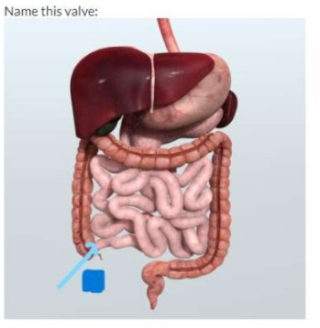 A)IleoappendixB)Pyloric sphincterC)DuodenorenalD)Ileocecal
- Which statement accurately characterizes the primary role of the human reproductive system?A)It coordinates sensory perception and integration.B)It synthesizes hormones for energy metabolism.C)It ensures the continuation of the species.D)It regulates fluid balance within the body.
- What is the effect of antidiuretic hormone (ADH) on the nephron?A)Stimulating thirst sensationB)Increasing blood pressureC)Increasing water reabsorptionD)Promoting sodium reabsorption
- The instructor is educating a group of nursing students about the regulatory mechanisms affecting water reabsorption in the nephron. Which renal structures are primarily influenced by hormones such as antidiuretic hormone (ADH) and aldosterone, leading to adjustments in the rate of water reabsorption?A)GlomerulusB)Loop of HenleC)Vasa rectaD)DCT and collecting duct
Exam Review
- Which of the following is true regarding normal quiet expiration of air?A)It depends on the complete lack of surface tension on the alveolar wall.B)It is driven by increased blood CO2 levels.C)It is a passive process that depends on the relaxation of inspiratory muscles.D)It requires contraction of abdominal wall muscles.
- Identify the effects of the renin-angiotensin-aldosterone system (RAAS) activation on the urinary system. (Select all that apply)(SATA)A)It promotes vasoconstriction of blood vesselsB)It stimulates thirstC)It lowers blood pressureD)It increases water reabsorption in the kidneysE)It stimulates the release of renin
- A client expresses concerns about frequent urinary tract infections (UTIs), constipation, fatigue, brain fog, and dry skin. Recognizing that the average adult's body mass of water percent body mass is _______ the healthcare provider identifies these symptoms as potential signs of dehydration and inquires about the client's water intake.A)70-80%B)10-20%C)30-40%D)50-60%
- Which of the following structures is typically considered a retroperitoneal organ?A)PancreasB)StomachC)LiverD)Spleen
Exam Review
- The instructor is assessing a student's understanding of digestive enzymes. Which statement by the student indicates a correct understanding of the salivary amylase enzyme?A)"It is an enzyme released into the duodenum."B)"It is an enzyme that breaks down the fats in breast milk."C)"It is an enzyme that initiates the breakdown of carbohydrates."D)"It is an enzyme that breaks down proteins in the stomach."
- The instructor is reviewing anatomy with a group of students. Which statement accurately describes the regions of the pharynx?A)From the lower esophageal sphincter to the duodenum.B)From the mucous membranes of the mouth to the tongue.C)From the oral and nasal cavities to the esophagus and larynx openings.D)From the oral and nasal cavities through the diaphragm to the abdomen.
- The respiratory membrane is composed of fused basement membrane of the capillary walls andA)Type I pneumocytesB)Respiratory bronchiolesC)Segmental (tertiary) bronchiD)Type II pneumocytes
- Which of the following sequences correctly represents the flow of urine from its formation to its elimination from the body?A)Calyx, nephron, collecting duct, urinary bladder, renal pelvis, ureter, urethraB)Nephron, collecting duct, calyx, renal pelvis, ureter, urinary bladder, urethraC)Nephron, renal pelvis, collecting duct, calyx, urinary bladder, urethra, ureterD)Collecting duct, nephron, renal pelvis, calyx, urinary bladder, ureter, urethra
Exam Review
- Which structure in the nephron is primarily responsible for reabsorption?A)Proximal convoluted tubuleB)Efferent arterioleC)Afferent arterioleD)Loop of Henle
- Which of the following is an abnormal constituent of urine?A)UreaB)AlbuminC)SodiumD)Creatinine
- Name this duct:A)Pancreatic ductB)Common bile ductC)Common hepatic ductD)Cystic duct
- _________ occurs when the external intercostal muscles contract, pulling the ribs up and expanding laterally.A)Vital capacityB)ExpirationC)InspirationD)Ventilation
Exam Review
- A biology instructor is assessing the understanding of reproductive processes among a group of students. Which statement accurately describes the primary purpose of spermatogenesis in males and oogenesis in females?A)Spermatogenesis and oogenesis both contribute to the maturation of the embryo.B)Spermatogenesis produces mature sperm for fertilization, while oogenesis generates mature ova for fertilization.C)Spermatogenesis is responsible for the development of the uterine lining, while oogenesis produces hormones to regulate the menstrual cycle.D)Spermatogenesis and oogenesis are sex hormones necessary for reproductive health.
- A nurse is providing education to a client who has recently undergone pelvic floor surgery. The client asks about the voluntary control of urination. Which anatomical structure allows for conscious control over the initiation of urine flow?A)Ileocecal sphincterB)Internal urethral sphincterC)Internal anal sphincterD)External urethral sphincter
- Identify the phases of the uterine cycle. (Select all that apply)A)Secretory phaseB)Proliferative phaseC)Ovulatory phaseD)MensesE)Luteal phase
- Identify the structure labeled C.A)AB)BC)CD)DE)E