Exam Review
- A nurse is assessing a patient with a Jackson-Pratt drain. The drainage has changed from red to pink over the past 24 hours. Which type of drainage is the patient exhibiting?A)SerousB)SanguineousC)PurulentD)Serosanguineous
- A clinical instructor is discussing pressure injuries during post-conference. Which statement by the student nurse indicates understanding of a pressure injury?A)"Localized damage to the skin and underlying tissue usually found over a bony prominence,"B)"Separation of wound layers as a result of excessive stress."C)"A collection of infected fluid that has not drained and interrupts wound healing."D)"Internal bleeding under the skin layers that causes skin breakdown."
- During a routine office visit, a patient takes off their sock and says "this awful sore won't heal." On inspection, the nurse notes the following:
A 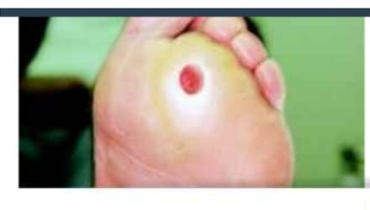 A)Deep-vein thrombophlebitisB)Venous stasis ulcerC)Arterial ulcerD)Neuropathic ulcer
- The nurse is assessing extraocular eye movements (EOM). Which action describes the correct assessment technique?A)Ask the patient to sit about 4 ft away facing the nurse.B)Use a penlight approximately 1 ft away from the patient's face and move it slowly in all 6 directions.C)Ask the patient to cover one eye with their hand.D)Move a penlight in a circular motion 1 ft away in front of the patient's eyes.
Exam Review
- The nursing student performs a skin assessment on a 85-year-old client. Which finding is most concerning?A)Skin remains red on the coccyx when pressed.B)Dry scaly skin on the lower extremities.C)Decreased tenting when assessing skin turgor.D)Skin tags on neck line.
- A client is ordered Lovenox for DVT prophylaxis. The physician orders 1.2 mg/kg subcutaneously once daily to be administered. The client weighs 185 pounds. Available is Lovenox 80 mg/0.8 mL. How many milliliters will the nurse administer? Round to the nearest tenth, if necessary, and label your answer.Correct Answer:1 mL
- The hospital nurse is preparing to administer a dose of penicillin antibiotic when the patient says, "The last time I took penicillin I got a very itchy rash and started wheezing." Which action should the nurse take?A)Assure the patient that the reaction was probably a side effect and not an allergy.B)Call the pharmacist.C)Withhold the medication and contact the prescriber.D)Administer the antibiotic and observe carefully for a reaction.
- A nurse is preparing to administer acetaminophen 320 mg PD every 4 hr PRN for pain. The amount available is acetaminophen liquid 160 mg/5 mL. How many mL should the nurse administer per dose? Round to the nearest tenth and label your answer.Correct Answer:10 mL
Exam Review
- A nurse is caring for a patient who reports severe chest pain rated "8" on a scale of 0-10. The patient states, "I don't like to complain about pain. What is the nurse's priority action to ensure patient safety?A)Administer a sleep medication to help the patient rest.B)Educate the patient about the importance of reporting chest pain immediately.C)Respect the patient's wishes and wait for the patient to ask for help.D)Document the patient is not a complainer in the medical record.
- Which patient would the nurse assess as being the greatest risk for sensory deprivation?A)An 45 year-old adult with a femur fracture that is working on a home computer.B)An 55 year-old adult who is in an oncology unit reading magazines brought in by friends.C)An 78 year-old aged adult who had a stroke with the lights off.D)An 70 year-old adult who is sitting in a chair with the television off visiting with family.
- The nurse is caring for a patient that has multiple monitoring systems constantly beeping and making noise. The patient is becoming agitated and frustrated over the inability to sleep. Which action by the nurse is most appropriate for this patient?A)Keep the door open during the night.B)Provide the patent with earplugs.C)Administer an opioid medication to help the patient sleep.D)Turn off the monitors at night.
- A physician orders 1000 mL of 0.9% NSS to be infused over 11 hours. How many mL per hour should the nurse set the IV pump? nearest tenth and label your answer.
Exam Review
- The nurse is assessing the abdominal wound of an obese patient. The nurse discovers the following finding:A)DehiscenceB)EviscerationC)FistulaD)Hernia
- The nurse observes the following injury. What does the nurse classify it as?A)Suspected deep tissue injuryB)Stage 2 pressure InjuryC)Stage 1 pressure injuryD)Unstageable pressure injury
- A nurse is developing a plan of care for a 68 year-old. Which information will the nurse consider?A)Should be standardized because most geriatric patients have the same needs.B)Needs to be individualized to the patient's unique needs.C)Focuses on the disabilities that all aging persons go through.D)Must be based on chronological age alone.
- The nurse is planning to administer a tuberculin test to a client with a 27-gauge, 5/8-inch needle. What angle will the nurse insert the needle?A)90 degreesB)15 degreesC)60 degreesD)45 degrees
Exam Review
- A nurse is planning a presentation for a group of adults greater than 70 years of age about health promotion and disease prevention. Which of the following would the nurse give the highest priority to recommend for this age group?A)Annual pap smearB)Pneumococcal immunizationC)Annual mammogramD)Human papilloma virus (HPV) immunization
- A nurse preceptor is working with a student nurse. Which behavior by the student nurse prompts the preceptor to intervene?A)Sharing patient information with another student.B)Reviewing the patient's medical record.C)Documenting medication administered to the patient.D)Reading the patient's plan of care.
- A patient is ordered an ophthalmic solution 1 drop tid daily to both eyes. The nurse understands that the eye drops will be administered:A)one drop to both eyes four times a dayB)one drop to both eyes as neededC)one drop to both eyes three times a dayD)one drop to both eyes two times a day
- Place the following steps for mixing NPH and Regular insulin in the correct order:A)Add air into the Regular insulin vailB)Remove the required dosage from the NPH insulin vialC)Remove the required dosage from the Regular insulin vialD)Add air into the NPH insulin vial
Exam Review
- A nurse is documenting on a client reporting chest pain. What assessment information is most important for the nurse to document?A)"Had poor results from the pain medication."B)Reports sharp pain of "8" on a scale of 0 to 10.C)"My family doesn't believe I'm in pain."D)Pupils equal and reactive to light.
- A nurse is following safety principles to reduce the risk of needlestick injury. Which actions will the nurse take? SELECT ALL THAT APPLY.A)Use clearly marked sharps disposal containers.B)Never force needles into the sharps disposal.C)Inspect needle before giving injection.D)Remove needle and dispose in sharps box.E)Recap the needle after giving an injection.
- What statement would best define stage 2 pressure injury?A)Full-thickness skin and tissue loss where subcutaneous fat is visibleB)Full-thickness skin and tissue loss where muscle, fascia, or bone is visibleC)Partial thickness skin loss with exposed dermisD)Nonblanchable erythema of intact skin
- A nurse is caring for a client admitted for stroke. The nurse begins discharge planning at what time?A)When the primary care provider writes the orderB)Upon admissionC)Right before dischargeD)After the congestion is treated